Electric vehicles have transformed the way drivers think about efficiency, performance, and energy management. Among luxury EVs, the Cadillac Lyriq stands out for its advanced technology, premium comfort, and customizable driving experience. One question frequently asked by current owners and prospective buyers is whether the driving modes in the Cadillac Lyriq actually affect range and battery consumption.
The answer is yes—but not because the vehicle’s battery capacity changes. Instead, different driving modes alter how the vehicle delivers power, manages regenerative braking, and responds to driver inputs. These adjustments can significantly influence real-world energy efficiency and ultimately determine how far the vehicle can travel on a charge. Understanding these differences helps drivers maximize both performance and range according to their specific needs.
Understanding Cadillac Lyriq Driving Modes
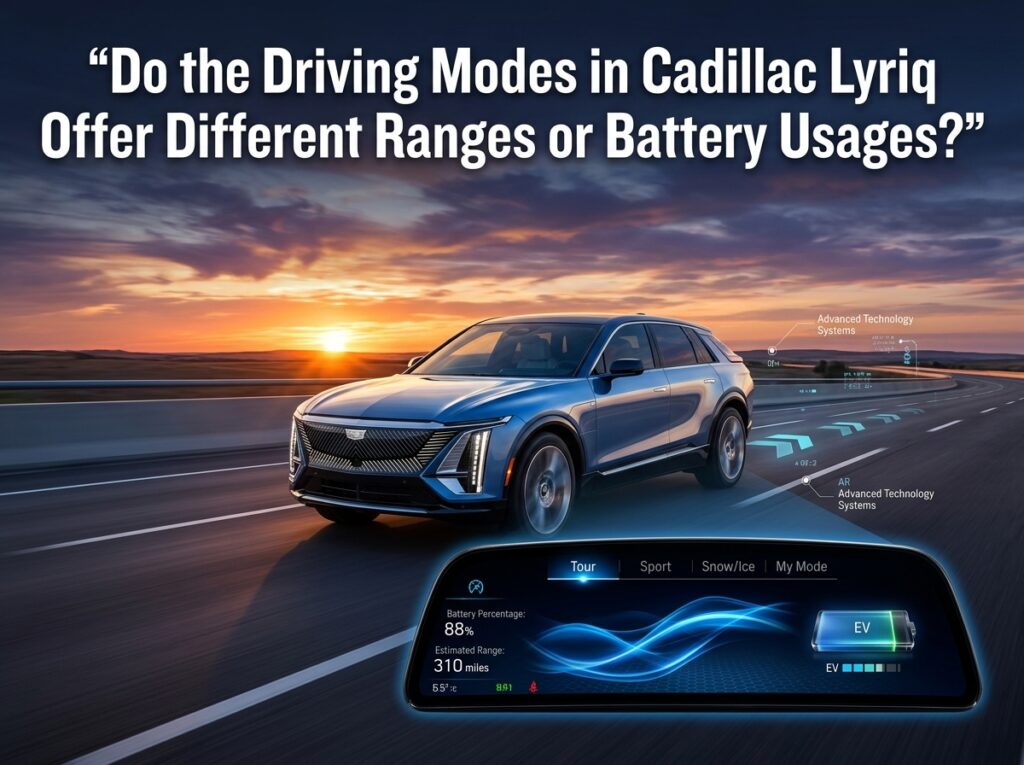
The Cadillac Lyriq offers multiple drive modes designed to tailor the vehicle’s behavior to different driving conditions. Depending on the model year and configuration, drivers typically have access to Tour Mode, Sport Mode, Snow/Ice Mode, and customizable My Mode settings.
Each mode changes several vehicle characteristics simultaneously. These include throttle sensitivity, steering feel, traction control behavior, power delivery, and regenerative braking performance. While the battery pack itself remains unchanged, the way energy is used throughout a journey can vary considerably based on the selected mode. This is why two drivers traveling the same route may experience different efficiency results depending on their drive mode choices.
Why Driving Modes Matter in an Electric Vehicle
Unlike traditional gasoline-powered vehicles, electric vehicles convert stored battery energy directly into motion. Small changes in power demand can have a noticeable effect on overall efficiency.
When a driving mode encourages rapid acceleration or more aggressive power delivery, the motors consume energy at a faster rate. Conversely, modes designed for efficiency often smooth throttle responses and optimize regenerative braking, allowing the vehicle to recover more energy during deceleration. This balance between performance and efficiency is central to understanding battery usage in the Lyriq.
Drivers who regularly switch between city commuting, highway travel, and adverse weather conditions can benefit from understanding how each mode influences energy consumption. The result is not merely a change in driving feel but potentially meaningful differences in real-world range.
Tour Mode and Everyday Efficiency
Tour Mode serves as the default setting for most Cadillac Lyriq models. It is designed to provide a balanced combination of comfort, responsiveness, and efficiency.
In Tour Mode, throttle inputs are moderated to encourage smoother acceleration. The vehicle’s regenerative braking system is configured to recover energy effectively while maintaining a natural driving experience. Steering effort and power delivery are calibrated for everyday driving situations, making this mode particularly suitable for commuting and long-distance travel. Many efficiency-focused drivers report that Tour Mode consistently delivers the best real-world range among the available settings.
Because the vehicle avoids unnecessarily aggressive power demands, battery consumption remains more predictable. For drivers prioritizing maximum miles per charge, Tour Mode is generally considered the optimal choice.
Sport Mode and Increased Energy Consumption
Sport Mode transforms the Cadillac Lyriq into a more responsive and engaging vehicle. Throttle response becomes sharper, acceleration feels more immediate, and steering characteristics often become firmer.
These enhancements create a more dynamic driving experience, but they typically come at the expense of efficiency. Rapid acceleration requires higher power output from the electric motors, which increases energy consumption. Even though the battery capacity remains identical, the vehicle may use available energy more quickly, resulting in reduced driving range under similar conditions.
Drivers who enjoy spirited driving may find Sport Mode highly rewarding, especially on open roads. However, those planning long trips or aiming to maximize battery life between charging sessions may prefer to reserve Sport Mode for specific situations rather than continuous use.
Snow and Ice Mode Explained
Winter weather introduces unique challenges for electric vehicles. Reduced traction, colder temperatures, and slippery surfaces can all affect efficiency and safety.
Snow/Ice Mode in the Cadillac Lyriq prioritizes stability and control. The system softens throttle response and adjusts traction management systems to reduce wheel spin. By carefully distributing power and limiting abrupt acceleration, the mode helps maintain grip in challenging conditions.
Although Snow/Ice Mode is primarily designed for safety rather than efficiency, its smoother power delivery can sometimes help prevent unnecessary energy waste caused by tire slip. Nevertheless, cold temperatures themselves often remain the largest factor affecting winter range, regardless of drive mode selection.
My Mode and Personalized Efficiency
One of the Lyriq’s most useful features is the ability to customize driving characteristics through My Mode. This allows drivers to tailor acceleration response, steering feel, and other settings according to personal preferences.
For efficiency-minded owners, My Mode creates opportunities to build a customized profile that balances comfort with maximum energy recovery. Some drivers choose softer throttle settings combined with stronger regenerative braking to improve urban efficiency. Others prefer a blend that maintains responsiveness while still prioritizing energy conservation.
The flexibility of My Mode demonstrates that efficiency is not solely determined by factory presets. Driver behavior and personalized settings can significantly influence how effectively battery energy is used throughout daily driving.
How Regenerative Braking Influences Battery Usage
Regenerative braking plays a major role in EV efficiency. Rather than converting kinetic energy entirely into heat through traditional friction brakes, regenerative systems capture some of that energy and return it to the battery.
The Cadillac Lyriq uses regenerative braking to improve efficiency during deceleration. Different driving modes can influence how aggressively this energy recovery occurs. Stronger regenerative braking generally increases energy recapture opportunities, especially in stop-and-go traffic.
For urban drivers, regenerative braking can contribute significantly to overall efficiency. While it cannot create energy, it helps recover energy that would otherwise be lost, improving the vehicle’s effective range over time.
Comparing Driving Modes and Their Efficiency Characteristics
| Driving Mode | Primary Focus | Throttle Response | Efficiency Potential |
|---|---|---|---|
| Tour Mode | Balanced daily driving | Moderate | High |
| Sport Mode | Performance and responsiveness | Aggressive | Lower |
| Snow/Ice Mode | Traction and stability | Gentle | Moderate |
| My Mode | User customization | Adjustable | Variable |
This comparison highlights that efficiency is closely linked to how power is delivered rather than the battery itself. The same battery pack powers every mode, but energy usage patterns differ substantially.
Drivers seeking maximum range typically benefit from smoother acceleration and higher regenerative braking utilization, both of which are easier to achieve in efficiency-focused configurations.
Real-World Factors That Affect Range More Than Drive Modes
While drive modes matter, they are only one part of the overall efficiency equation. Several external variables often have an even greater impact on range.
Key factors include:
- Driving speed
- Outside temperature
- Tire pressure
- Terrain and elevation changes
- HVAC and climate-control usage
- Passenger and cargo weight
- Wind resistance
These variables can significantly alter battery consumption regardless of which drive mode is selected. High highway speeds, for example, often reduce efficiency more dramatically than switching between Tour and Sport modes.
Highway Driving and Battery Consumption
Highway travel places unique demands on electric vehicles. Aerodynamic drag increases rapidly with speed, requiring more energy to maintain momentum.
During long-distance trips, Tour Mode often proves beneficial because it encourages smoother acceleration and consistent energy use. Drivers who engage Sport Mode on highways may experience increased battery consumption due to more aggressive power delivery and acceleration behavior.
Maintaining moderate speeds frequently produces greater efficiency gains than changing drive modes alone. This principle applies across virtually all electric vehicles, including the Cadillac Lyriq.
City Driving and Energy Recovery
Urban environments provide numerous opportunities for regenerative braking to capture energy. Frequent stops, lower average speeds, and variable traffic patterns create ideal conditions for energy recovery systems.
In city driving scenarios, efficiency-focused settings can significantly improve overall energy utilization. One-pedal driving, combined with regenerative braking, often allows drivers to recover more energy during deceleration while reducing reliance on traditional brakes.
This makes urban driving one of the areas where driving mode selection can have the most noticeable impact on real-world efficiency and battery usage.
The Relationship Between Performance and Efficiency
Every vehicle involves a balance between performance and efficiency. The Cadillac Lyriq is no exception. Drivers seeking maximum acceleration naturally require higher power output, which increases energy consumption.
Sport-oriented settings prioritize responsiveness and engagement. Efficiency-oriented settings prioritize smoothness and energy conservation. Neither approach is inherently better; each simply serves a different purpose.
Understanding this tradeoff helps drivers make informed decisions. A driver focused on commuting may prefer efficiency, while someone seeking a more dynamic experience may willingly accept higher energy consumption.
Battery Capacity Versus Battery Usage
A common misconception is that driving modes somehow alter the battery’s capacity. In reality, the Lyriq’s battery pack remains the same regardless of mode selection.
The difference lies entirely in how quickly energy is consumed. Think of it as spending from the same bank account at different rates. One mode may encourage conservative spending, while another promotes faster use of available resources.
This distinction is important because it explains why range changes without any physical modification to the battery itself.
Practical Tips for Maximizing Cadillac Lyriq Range
Drivers looking to achieve the highest possible efficiency can benefit from several practical strategies.
| Strategy | Potential Benefit |
|---|---|
| Use Tour Mode for daily driving | Improved efficiency |
| Maintain proper tire pressure | Reduced rolling resistance |
| Utilize regenerative braking | Increased energy recovery |
| Avoid rapid acceleration | Lower power consumption |
| Precondition the vehicle while charging | Reduced battery demand during travel |
These practices often deliver greater efficiency improvements than focusing solely on drive mode selection. Combined together, they can help maximize every charge.
How Cadillac’s Technology Supports Energy Management
Cadillac integrates sophisticated software systems that continuously monitor energy use, battery conditions, and driving behavior. These technologies help optimize efficiency regardless of the selected drive mode.
The vehicle’s energy monitoring displays allow drivers to see where power is being used, including propulsion, climate control, and battery conditioning systems. This visibility encourages more informed driving decisions and helps owners identify opportunities to improve efficiency.
Modern EV technology demonstrates that range optimization is not solely about hardware. Intelligent software management plays an increasingly important role in maximizing real-world driving distance.
Conclusion
The driving modes in the Cadillac Lyriq do affect real-world range and battery usage, but they do not change the battery’s actual capacity. Instead, they influence how efficiently energy is consumed through adjustments to throttle response, regenerative braking, traction control, and power delivery. Tour Mode generally provides the highest efficiency, while Sport Mode prioritizes performance at the expense of greater energy consumption. Snow/Ice Mode focuses on safety and stability, while My Mode offers personalized control over the driving experience.
For most drivers, maximizing range involves more than selecting a particular mode. Driving habits, speed, weather, terrain, and energy management practices all contribute to overall efficiency. Understanding how these factors work together allows Cadillac Lyriq owners to tailor the vehicle to their preferences while making the most of every charge.
Frequently Asked Questions
Do Cadillac Lyriq driving modes change battery capacity?
No. The battery capacity remains the same regardless of the selected driving mode. Drive modes only affect how energy is used.
Which Lyriq driving mode offers the best range?
Tour Mode is generally considered the most efficient setting and often delivers the best real-world range.
Does Sport Mode reduce range?
Yes. Sport Mode typically increases energy consumption because it delivers more aggressive acceleration and power response.
Is Snow/Ice Mode more efficient?
Snow/Ice Mode is designed primarily for traction and stability rather than efficiency. However, smoother power delivery may help reduce unnecessary energy loss in slippery conditions.
Does regenerative braking improve battery usage?
Yes. Regenerative braking recovers some energy during deceleration and returns it to the battery, helping improve overall efficiency.
Can My Mode improve efficiency?
Potentially. Drivers can customize settings to favor gentle acceleration and stronger regenerative braking, which may improve efficiency under certain driving conditions.